
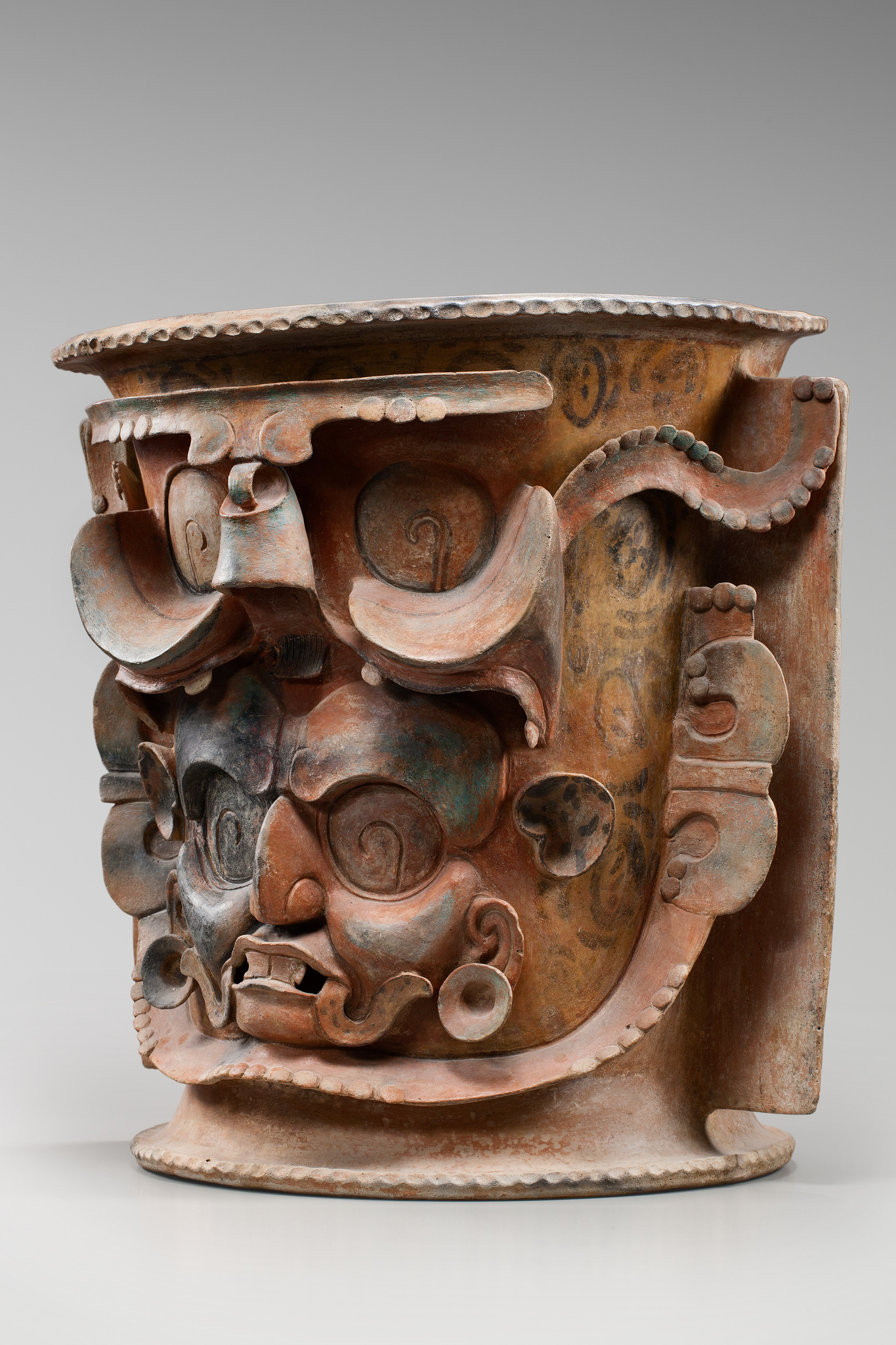
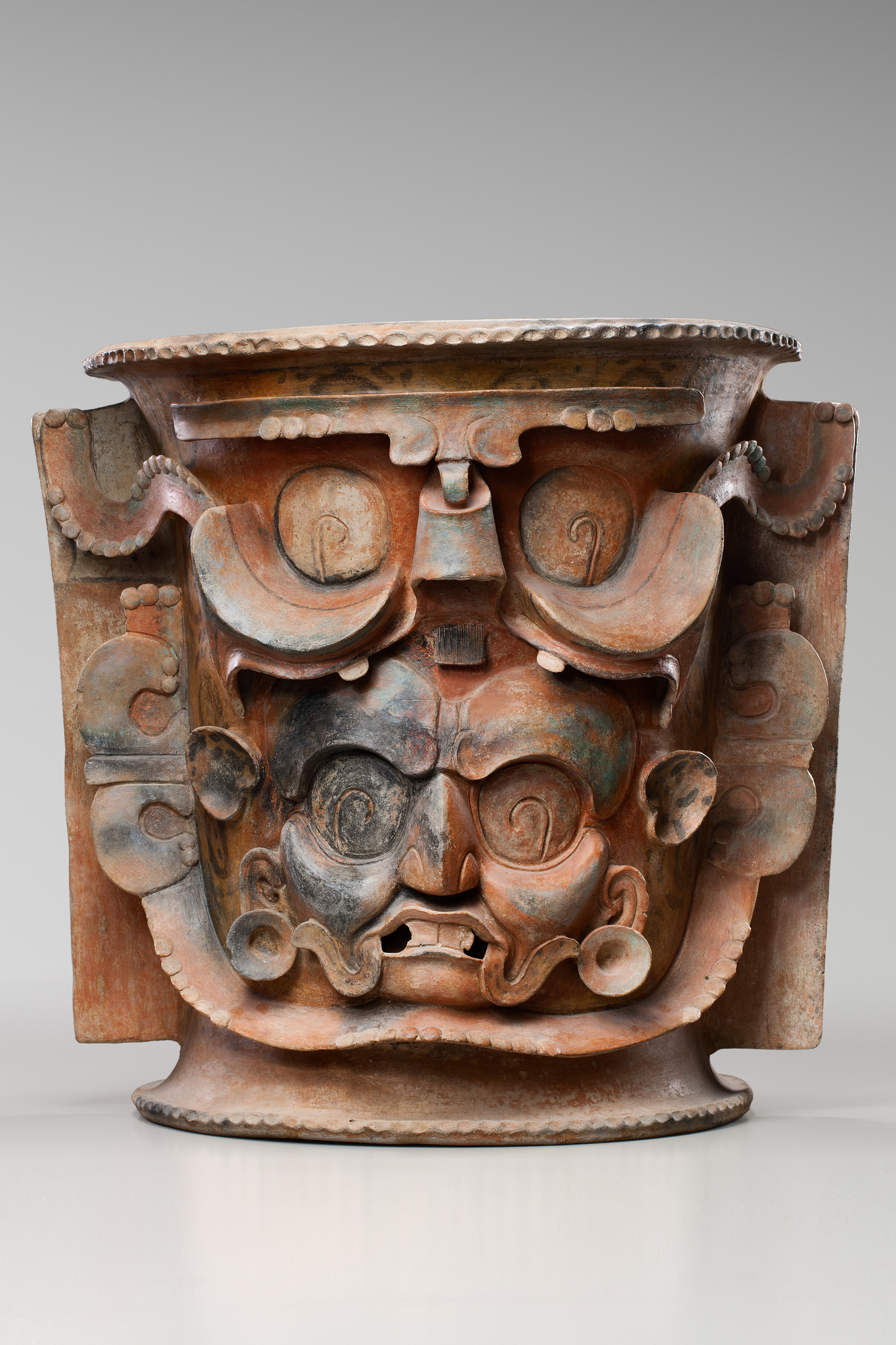
Monumental urn, Classic Period, ca. 400 - 800 AD · Guatemala, Western Highlands, K’iche’ Maya (Quiché) · ID: 3052914
Marianne Huber, Antwerp, Belgium (1985)
Galerie Alt-Amerika, Ulrich Hoffmann, Stuttgart, Germany (1993)
Description
ceramic, turquoise blue, red, yellow, black and white pigments,
The object underwent extensive restoration in 2001, during which earlier, unsatisfactory restoration interventions were largely removed. A detailed conservation report with photographic documentation is available.
Urns from the K’iche region of Guatemala are the largest plastically decorated ceramic vessels created by the Maya. The present example exceeds the size of most comparable pieces known today.
These urns contained the remains of important individuals, who were either placed inside as tightly bound funerary bundles or interred as secondary burials consisting of the remaining bones. Some urns were fitted with lids, which could be elaborately modeled with figural decoration. An urn from the Museo Popol Vuh in Guatemala City serves as a comparative example (see photograph). Incense burners used for the burning of copal resin during ritual ceremonies are believed to have been placed atop the urns, accompanying and activating their ceremonial function.
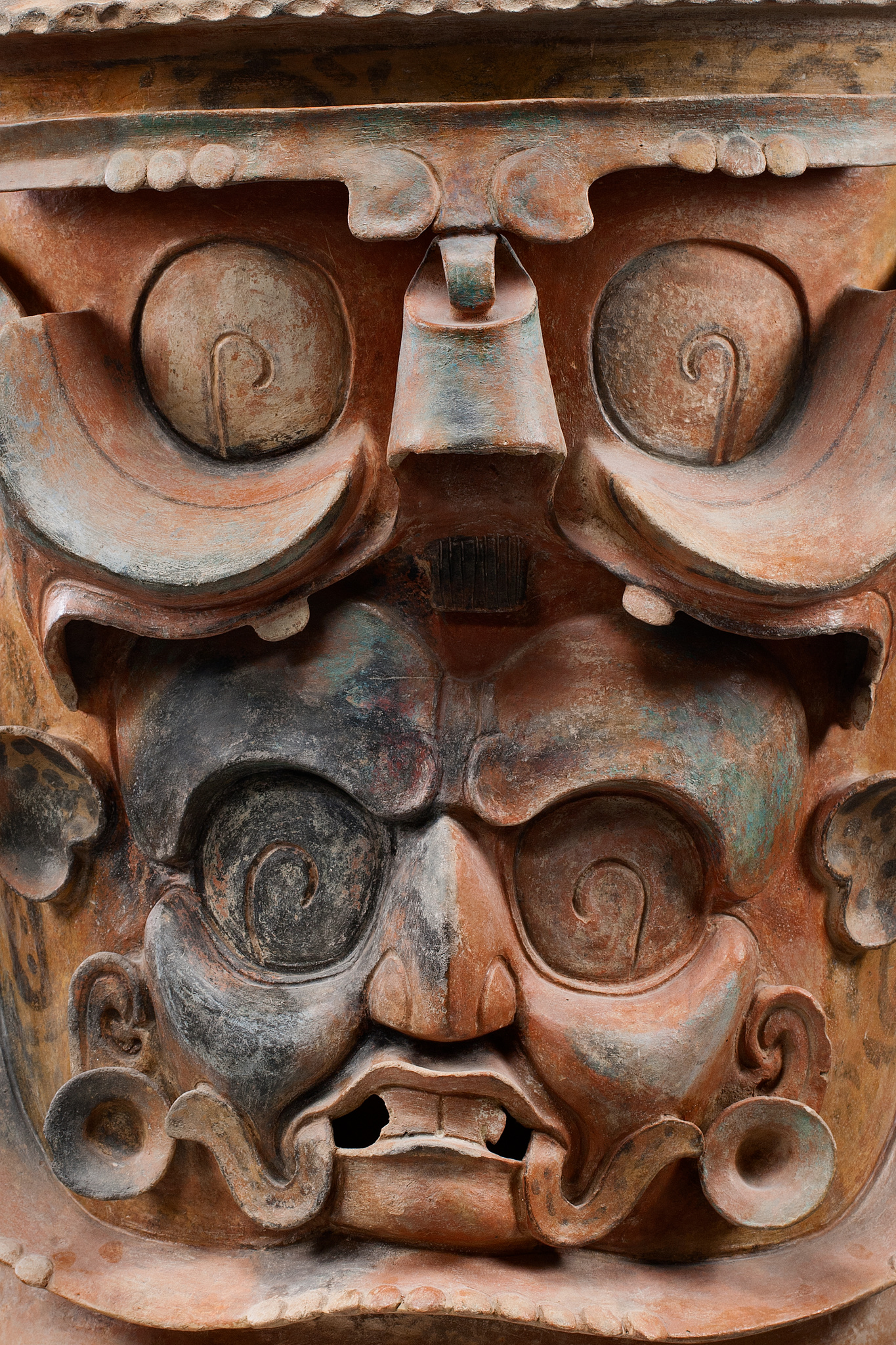
The iconography of most of these urns depicts ancestors emerging from the gaping jaws of vision serpents. Such imagery refers to the generation of visions and the invocation of ancestors. Jaguars also appear in this context, as in Maya cosmology the jaguar is associated with the night and with underworld iconography (after Eggebrecht, p. 564).
The front of this urn is adorned with the image of what is likely an ancestor who, after death, was transformed into the spiritual embodiment of a deity. The figure may represent the “Jaguar God of the Underworld,” regarded as the nocturnal counterpart of “Kinich Ahau”, the sun god known from the “Popol Vuh”. He gazes out from the massive jaws of an earth monster, which likewise displays feline characteristics, evidenced by the heart-shaped ears and the spotted pelt pattern. Symbolically, the earth monster embodies the underworld. Its open jaw functions as both entrance and exit to the interior of the earth: it devours and releases anew, giving rise to renewed life. This iconography may allude to the Maya belief in the sun’s daily rebirth, intrinsically linked to the life and prosperity of humans, animals, and plants.
These urns were placed at the entrances of caves, temples, or water sources known as cenotes—sites regarded as thresholds between the surface of the earth and its interior.
Due to the rarity of Maya K’iche’ urns, only a small number of museums possess comparable examples. The majority are believed to be housed in the Museo Popol Vuh in Guatemala City. A K’iche’ Maya urn of similar form and iconography, formerly in the John Bourne Collection, entered the collection of the Walters Art Museum in Baltimore in 2009 (accession no. 2009.20.41). Another example, from the collection of Jorge y Ela Castillo, Guatemala, is published in Henri Lehmann, Arts Mayas du Guatemala, Paris 1968, p. 162, fig. 245. Both urns, however, are considerably smaller than the present example (Walters Art Museum: h: 55.8 cm / w: 67 cm; Guatemala piece: h: 52 cm).
Expertise
Thermoluminescence report, No. 961017, R. Kotalla, Haigerloch, 17 October 1996
Comparing literature
Eggebrecht, Eva & Arne, (ed.), Die Welt der Maya, Mainz 1992, p. 565, ill. 233 Lehmann Henri & Suzanne, Arts Mayas du Guatemala, Paris 1968, p. 162, ill. 245 Hellmuth, Nicholas M., Elderly féline-humanid emerging from monster mouth, a special example of Classic Maya art of the Quiche Highlands, October 1994
Publications
Hoffmann, Ulrich, Faszination Alt-Amerika, Stuttgart 2002, p. 81; Hoffmann, Ulrich, Schätze Alt-Amerikas, Stuttgart 2012, p. 126, ill. 1; Expo cat.: Serge Schoffel, Art Premier, Brussels, Belgium, 2016, p. 126-129
Exhibition
Köln, Rheinauhafen, Imhoff-Stollwerck-Museum, April 1997 - April 1999 (on loan to the museum); Brussels, Belgium, "BRAFA" (Brussels Antiques & Fine Arts Fair), 23-31 January 2016 (Serge Schoffel)
Notices
This object is subject to the UNESCO Cultural Heritage Protection Act. Export documents are required for export (subjected to a fee).