
Throne Seat "rü mfo", Bamum Kingdom
by Dr. Bettina von Lintig, San Francisco, July 2026
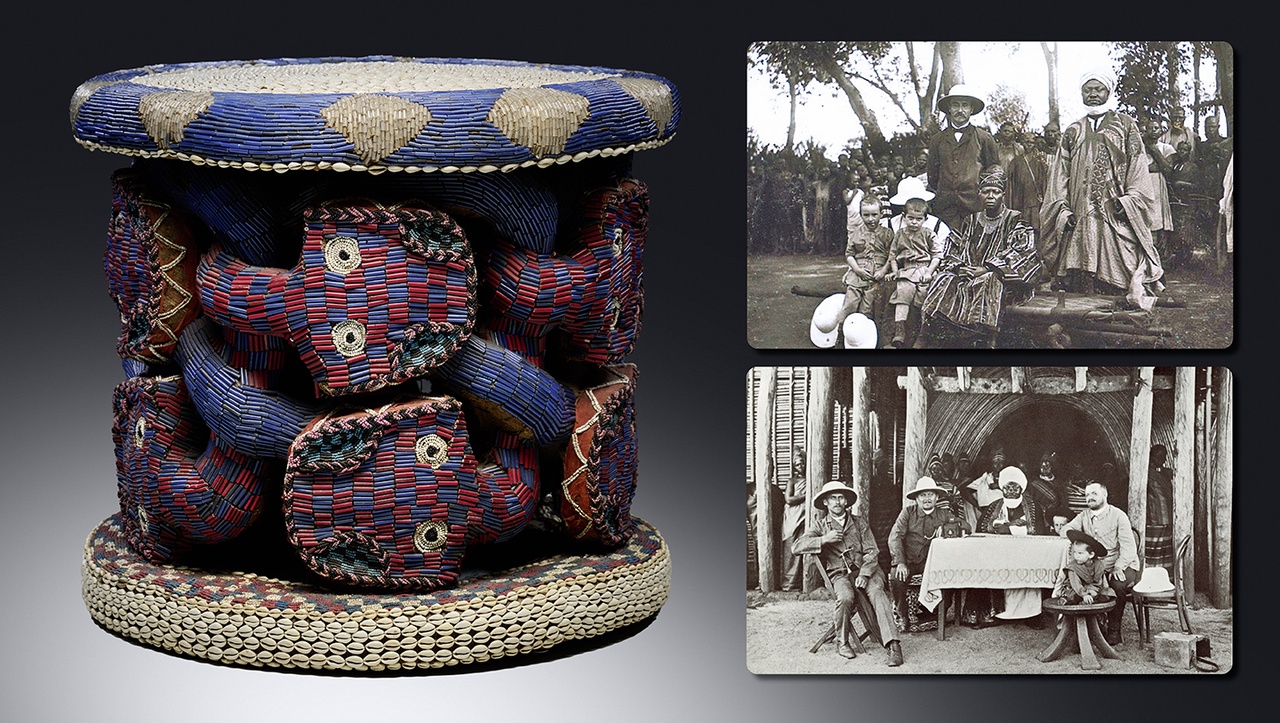
Provenance
Sultan Ibrahim Njoya collection, Foumban, Cameroon
A personal gift from Ibrahim Njoya to Martin Göhring, the Basel Mission’s envoy, between 1906 and 1911
Göhring family collection; according to Theodora Göhring, daughter of Martin Göhring, this throne belonged to the king’s mother, Njapundunke
It was likely carved in the workshop of Nji Nkome and embellished with beads and cowrie shells by Menyam specialists. Restoration work was done later by Western owners
This circular throne stool from the Kingdom of Bamum (lot 58), now also a prefecture in western Cameroon, is a truly special object in many ways.
Abundantly embroidered with beads and cowrie shells, it was likely created before 1900. It subsequently became the property of a European family for a long period of time, after being personally presented as a gift to a missionary of the Basel Mission, who maintained friendly relations with the ruler of the Bamum from 1906 to 1911/1912. This is the story of how that happened:
On April 11, 1906, a delegation of Swiss missionaries arrived in Bamum. King Njoya received them on horseback, wearing a richly embroidered white Hausa robe. His bodyguards wore red velvet uniforms inspired by German military jackets and trousers (not exact copies, but rather free interpretations of them), which were also embroidered. King Njoya’s armed bodyguard contingent, numbering between twenty and thirty men, always accompanied him on his excursions, and later on his visits to the mission station or to religious gatherings.[1]
The king was interested in establishing new connections and relationships with people who could inspire his creativity and satisfy his thirst for knowledge. At the same time, he had every reason to be very cautious, not only with strangers, but also with his own relatives and high-ranking court officials. He had to be a skilled politician to handle this complicated situation.
The history of the Bamum Empire in the 19th century was marked by usurpations, and the period of Njoya’s rule was no exception. Most recently, in 1894, he and his loyal followers had brutally crushed a rebellion. At the age of twelve, Njoya had already been crowned the 17th ruler of the Bamum after his father, King Nsangu, had fallen in battle against the neighboring kingdom of Nso. Nsangu’s own half-brothers had been responsible for killing him. Nsangu’s mother and Njoya’s mother had to eliminate rivals and protect the heir when the underage Njoya became the leader of the Bamum.[2]
Njapundunke, a shrewd and powerful woman, acted as her son’s regent until he was about 19 years old. A detailed history of the kingdom from the Bamum perspective is contained in the chronicle that King Njoya later composed himself, together with his courtiers. As early as 1900, they began developing a writing system for Shümon, the language of the Bamum, and subsequently created several increasingly refined alphabets.[3] This gave rise to a version of history created not from a European perspective, but rather from their own. Stories and administrative matters could also be recorded and printed in the Bamum language script.
It was ultimately Queen Mother Njapundunke who convinced her son in 1906 to cooperate with the Basel Mission.[4] King Njoya himself was weary of war.
It should be noted that Njoya professed Islam while remaining a practitioner of traditional Bamum rituals. He was only able to defeat his adversaries in 1894 with the help of Fulbe cavalry from Banyo. In return, he made certain concessions; among other things, he and a small Bamum elite converted to Islam. Hausa and Fulbe garments, horses, and weapons soon became part of the new appearance of the privileged class in Foumban. Thanks to the support of the Fulbe (Peul), King Njoya enjoyed unrestricted authority over the kingdom. At the beginning of the 20th century, he ruled over a territory of about 8,000 square kilometers. Foumban, the thriving capital, had a population of 15,000 to 20,000.[5]
Ultimately however, the events that would shape the fate of King Njoya and the future of the kingdom took place elsewhere – in the capitals of Europe and the coastal cities of the African continent.[6]
The Basel Mission Station in Foumban was founded in 1906 as the second Christian outpost in the Cameroonian Grasslands, three years after the first one in Bali-Nyonga. Beginning in 1905 and 1906, the Bamum replaced the Bali as the German colonial government’s most important allies in the Cameroonian Grasslands.[7]
As a political gesture and a symbolic act that was also practiced among local allies, gifts to explorers, civil servants, and peaceful military personnel, as well as to missionaries from Europe, were not uncommon at the time. There are many other examples of them, but an unusually close relationship developed between the Swiss Martin Göhring (1871–1959), who was stationed in Foumban by the Basel Mission as a resident representative from 1906 to 1911, and King Njoya.[8] The king supported the missionaries’ work by sending boys and girls to the mission school so they could learn to read and write, and he had them participate in sewing and embroidery classes. A temporary church was built, which Njoya himself hardly ever attended. For his part, Göhring learned the writing system devised by Njoya and his assistants for the Shümon and Bamum languages. He also represented Njoya’s interests vis-à-vis the German colonial authorities, for example when the African king was taken advantage of by German merchants in the rubber or ivory trade. The Göhrings gave their sons local names; they were called Fonyonga and Njoya.[9]
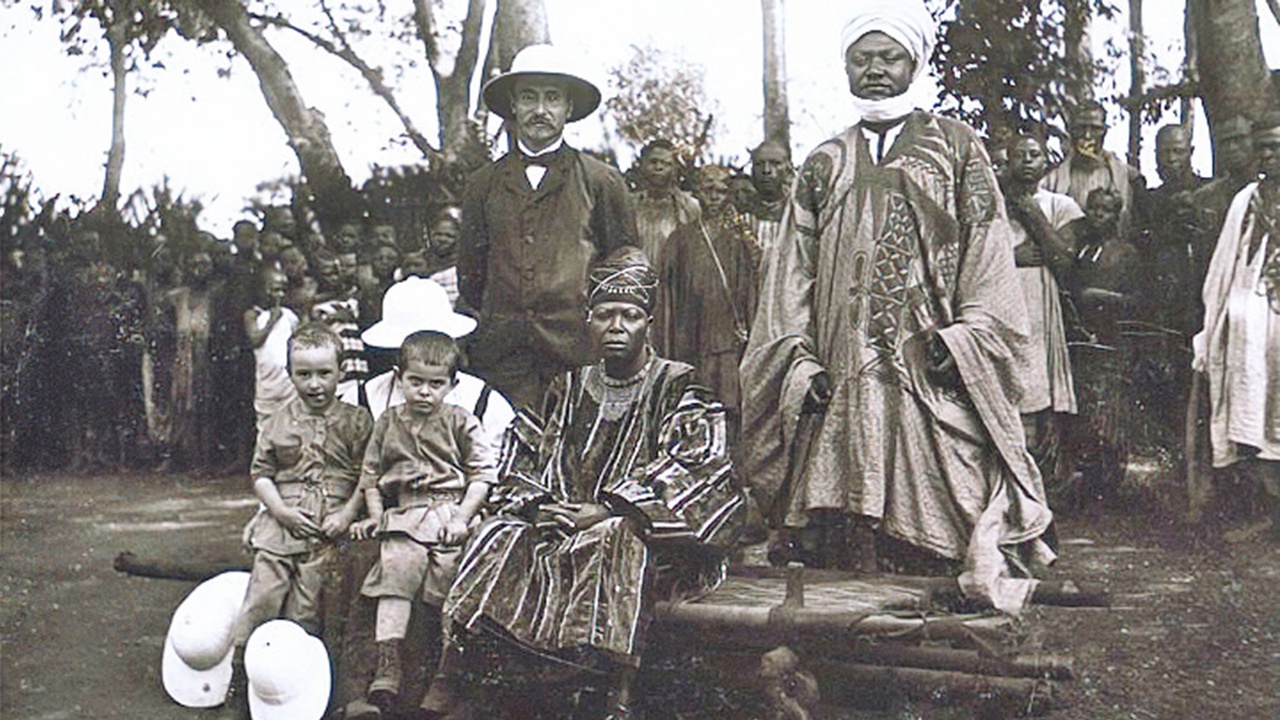
Historic group photo: Martin Göhring and Sultan Ibrahim Njoya (both standing), with the Göhring sons Fonyonga and Njoya beside Queen Mother Njapundunke; Margarete Göhring-Kalmbach is partly visible behind the sons.
The friendly relationship between the Göhring family and the king is documented in photographs from that time. In one photo taken by Göhring himself, the young children are seated at a table with the king and missionaries; in another, Martin Göhring, Ibrahim Njoya, Queen Mother Njapundunke, and the Göhring sons (who obscure Margarete Göhring-Kalmbach in the photo) are visible. In the background, the Bamum people look toward the camera.[10]
All of this lends plausibility to the statement by Martin Göhring’s daughter, Theodora, that the king gave the throne to her father as a gift. Furthermore, this is said to be a throne seat that belonged to Queen Mother Njapundunke, and that it came from the royal treasury. It was in damaged condition when it subsequently came into the possession of Munich gallery owner Arno Henseler, who acquired it around 1980. Thanks to the old beads that were still present and to the addition of some cowrie shells, the throne was successfully restored.
Description of the Throne
The throne is 69 cm high and 76 cm across. The seat rests on several snakes carved in a full-relief style. Their intertwined bodies are only partially visible from the sides; in each case, two flat snake heads – one facing right and the other left –are stacked one above the other to support the stool, with this design element repeated five times. The flat snake heads have round eyes embroidered with seed beads. In many respects, these heads resemble those seen on Njoya’s famous great mandu yenu throne. For example, the style of the bead embroidery is identical to that of the border edging around the faces, and nostrils are also depicted. The borders consist of arrow-shaped elements arranged in sequence and in alternating contrasting colors. In Bamum, the arrow motif was associated with the spear and with war. Unlike on the large mandu yenu, the Queen Mother’s throne features mainly rod beads for the snake embroidery; these are arranged in a blue-and-red checkerboard pattern on the faces and along the curves of the bodies, while some bodies are embroidered in a single color using only dark blue rod beads.
As a symbol, the mythical two-headed snake mfüet corresponds to a well-known Bamum royal emblem, which is also used in the mandu yenu as a “caryatid”.[11] In this case, beneath the seat, several two-headed snakes repeat the symbol. The mfüet refers to a historical event – one in which an ancestor fought bravely and victoriously on two fronts. The mfüet thus represents strength and courage[12]. Animals endowed with admired qualities – mostly predators and the strongest species in the animal kingdom, like elephants, giant snakes, and leopards – appear symbolically among the Bamum on masks or on the status symbols of the powerful. This throne with cowrie shells and beads is among the latter.
The checkered patterns in the beadwork are considered abstract representations of the leopard; they represent the big cat’s fur pattern. The seat and the rim of the base of this stool are coated with cowrie shells. The outer ring of the seat is decorated with light-colored rhombuses on a dark blue background made of rod beads, very similar to that seen on the mandu yenu throne, where red triangles on a blue background appear in this spot. Above the cowrie shells at the base of this queen mother’s throne stool, there is a blue, white, and red pattern of small checks, whose esoteric meaning is unknown.
Given the similarities we note between the two thrones being compared, I believe it is reasonable to assume that the stool supported by several two-headed snakes was also carved by the Nguot artist Nji Nkome and members of his lineage, who are known to have created the mandu yenu. The high level of craftsmanship in the embroidery suggests that it was executed by Menyam specialists who worked for the Bamum court.
The arts were associated with court rituals in Bamum, and the courtly arts developed in the mid-19th century following a period of military expansion. At that time, there were already several centers with specific craft specializations in the Cameroonian Grasslands. King Mbuembue settled artists renowned for their special skills near the palace, selecting them from among the ethnic groups that Bamum had subjugated. These included, for example, the Nguot, who were known for sculpture, metal casting, and beadwork. They also created opulent court furnishings for the Bamum. Artists from Menyam covered wooden sculptures that were already impressive in their own right with raffia fabric or ruffles, and in some places with red felt; onto these, they embroidered small round glass beads or valuable rod beads. White cowrie shells were also embroidered onto the pieces. These shells were also used as currency in Bamum in the 19th century.[13]
Nji Nkome was an outstanding sculptor among the Nguot. He and the members of his workshop created some of the most impressive thrones and sculptures of the Bamum kings.[14]
This throne’s design and expressive power make it unique. Even the sculpted snake bodies are somewhat different from those observed on other known examples featuring the serpent motif. Based on the pieces we know in a similar style[15], we can nevertheless surmise that the royal workshops once worked at full capacity to create ritual objects such as this one. The thrones were not necessarily used for sitting on, but could also serve as freestanding display works with mythical and symbolic significance during ceremonies. They were kept in a treasury and brought out only rarely.
It can be assumed that this example was one of several that belonged to Njapundunke. When presented as a gift, an object like this throne became a statement and a manifestation of mutual respect.
Notes
[1] Göhring, M., May 13, 1906. Erste Eindrücke (E-2.22.279) quoting Geary, Christraud, M., 1996, Political Dress; German Style Military Attire and Colonial Politics in Bamum; in African Crossroads. Intersections between History and Anthropology in Cameroon; ed.by Ian Fowler, David Zeitlyn, Providence USA/Oxford UK, pp. 179f
[2] Tardits, Claude, 1980, Le Royaume Bamoum, Librairie Armand Colin, Paris, pp. 915, 919
[3] Tardits, C., 1980, idem, pp. 210f
[4] Bozsa, Isabella, 2019, Geschenkt, gekauft, erbeutet – Missionarisches Sammeln in Kamerun und Indien. Basel, Museum der Kulturen, p. 46 [https://www.mkb.ch/de/museum/forschung/publikationen/publikationen-im-pdf-format.html]
[5] Geary, Christraud M., 1988, Images from Bamum. German Colonial Photography at the Court of King Njoya. Cameroon, West Africa, 1902 – 1915; Washington D.C. and London, p. 23
[6] Ibidem
[7] Bozsa, Isabella, 2019, see [4], pp. 45f
[8] Between 1900 and 1933, Martin Göhring donated 39 items to the Mission Museum. Twenty-eight objects in the collection have been identified. See Bozsa, Isabella, 2019, see [4], p. 46. A palast stool, which is partly embroidered and partly inlaid with copper alloy leaves, is now in the collection of the Rietberg Museum in Zurich. It also came from the Göhring family’s collection.
[9] Geary, Christraud M., 1988, see [5], p. 27, fig.6
[10] Bozsa, Isabella, 2019, see [4], p. 47, ill. 16
[11] Geary, Christraud M., 2008, Cat. 6, Großer Thron mit Figurenpaar und Fußbank, mandu yenu – Nguot-Künstler Nji Nkome, etwa 1870; in Kamerun – Kunst der Könige; ed. Lorenz Homberger, Rietberg Museum, Zurich, pp. 122f
[12] Geary Christraud M., 2008, Bamum und Tikar: Inspiration und Innovation; in Kamerun – Kunst der Könige, see [11], p. 33
[13] “A number of saltwater snails with glossy shells are known as cowries. The cowrie in this case, Cypraea annulus, is found in the Indian and Atlantic oceans, and its white shell was traded throughout West and East Africa. Cowrie shells were commonly used in the arts and as money”, quoting Geary, Christraud M., 1988, see [5], p. 137, #13. The glass beads made their way to the Cameroonian Grasslands via transatlantic trade, even before Europeans knew of the hinterland beyond the coast.
[14] Geary, Christraud M., 1988, see [5], p. 22
[15] Several Bamum thrones featuring the double-headed snake motif can be used for comparison: 1) The Palace Museum in Foumban, Cameroon, houses “a royal beaded throne with a female figure, attributed to King Nguwo’s reign (ca. 1850 to 1865–72); wood, cloth, glass beads, cowrie shells. Height: 208 cm, height of figure: 140 cm”, photo by Ch. M. Geary. 2) A chair with a backrest made of wood, beads, cowrie shells, and embossed copper is illustrated in the catalog of the Barbier-Mueller Collection. Double-headed snakes are integrated into both the backrest and the base. Pierre Harter writes that this type of seat is said to have been reserved for the second most important person in the state, the Queen Mother Njapundunke; see African Art from the Barbier-Mueller Collection; ed. Werner Schmalenbach, Munich, 1988, p. 192, # 116. 3) The Rautenstrauch-Joest Museum in Cologne has a rü mfo throne chair from Foumban, dated to 1880. It is said to have been a gift from King Njoya to Governor Jesko von Puttkamer around 1907. See Cameroon – Art of the Kings, 2008, see [11], pp. 122f, Cat. 6